60 Propositions for furthering mediation – report from the 2nd International Congress on all Mediations
Posted: 28 September 2023 Filed under: administrative justice, administrative mediation, Dispute resolution, human rights, international, mandatory mediation, Mediation, system design | Tags: 2nd International Congress on All Mediations, citizens, conference, dispute resolution, mediation Comments Off on 60 Propositions for furthering mediation – report from the 2nd International Congress on all MediationsLast year, at the 2nd International Congress for all Mediations held in Angers, France, I contributed to a roundtable discussion on mandatory administrative mediation (see post here). With colleagues from France and Spain, I discussed the uses of mediation in disputes involving individuals and public bodies, disputes that often involve key public services and fundamental social rights.
The official report of that Congress has now been published, and it contains 60 propositions for developing mediation in a wide range of areas, from climate issues and violence against women to schools, health care, neighbourhoods, and public administration.
I was pleased to see that the propositions put forward from the session on administrative mediation do not include a recommendation for mandatory mediation – there was lively debate at our roundtable on this topic. They do, however, recommend mandatory mediation information sessions for parties, along the lines we currently have in England for disputes about special educational needs and disabilities (SEND) and divorce and separation. The aim of such information sessions is to ensure that parties in dispute have the opportunity and knowledge to make an informed choice about whether or not to use mediation.
Administrative mediation as a means of humanising state bureaucracy
I was also pleased to see that the administrative mediation propositions reflect arguments I made at the Congress for mediation to be used as a resource for fostering a better, more trusting citizen-state relationship, one that prioritises listening and participative democracy. Proposition 43 states clearly that prior to introducing mandatory mediation, it is necessary to embed a culture of ‘humanization of the bureaucracy, reasonable public decisions, listening and trust’.
This proposition reflects the themes in the book I co-authored with Nick O’Brien, who is also a practitioner in administrative justice (tribunal judge in the SEND and Mental Health Review Tribunals). In Reimagining Administrative Justice: Human rights in small places, we set out a reimagined administrative justice landscape, one less constrained by legalism and more closely aligned with human rights and social rights, with what we call a ‘mediation mentality’ at its core.
The report and the 60 propositions
The full report, in French, is available to view or download below.
Below is a summary of the session on administrative mediation, including propositions arising from that session. (I don’t read French, so the translation is courtesy of Google Translate.)
DEVELOPMENT OF ADMINISTRATIVE MEDIATION
How to develop prior mediation and mediation at the initiative of the judge? Does the obligation to mediate contribute to its democratization?
Moderator: Rhita Bousta, Doctor of Law – University of Paris I Panthéon-Sorbonne, HDR lecturer at University of Lille (France).
Speakers: Amaury Lenoir, National Delegate for Mediation for Administrative Jurisdictions COUNCIL OF STATE, Mediation Referent at the Administrative Court of Nice, Mediator (France); Manel Canyameres Lawyer-Mediator (ALTERSIM Firm) (Spain); Margaret Doyle Independent mediator specializing in disputes involving equality issues, researcher in the field of public sector dispute resolution and administrative justice (UK); Bertrand Maréchaux, Mediator, honorary prefect, head of the “administrative mediation” commission of the ANM (France).
The Council of State recalled the benefits of mediation for resolving or preventing a dispute, creating or re-creating social bonds. However, he notes that the actors concerned are still too often hesitant to resort to mediation, even when it is offered to them by the administrative judge. Thus, by requiring those mediated to contact a mediator before being able to refer the matter to the administrative judge, the MPO is an accelerator of the development of mediation in the pre-litigation phase where it is, by nature, more timely and more effective.
In England, the MPO was recently introduced in two areas: on the one hand, conflicts between local government and families over the education of children with disabilities (“SEND”); on the other hand, as a condition for judicial referral for civil disputes for an amount less than £10,000. Also, mediation with a public administration is not only a quick and inexpensive procedure for the parties: the MPO should be based on the interest of all (good management of public funds, good administration).
This procedure raises more pronounced reluctance in Spain. Although it seems ruled out for the moment, a reform establishing compulsory mediation in the area of civil procedure is, however, on the verge of being adopted. Unlike France, it is liberal mediators who are called upon in Spain: the prospect of an MPO with an administration supervised by an institutional mediator is very unlikely.
It is therefore the legal and administrative culture which is the key element of reflection. In France, administrative mediation and the MPO in particular, while desirable, still encounter numerous obstacles coming both from the State, a public “power” disinclined to negotiate, and from magistrates or lawyers sometimes opposing in a binary manner the law (to prevail) and the equity. The two-headed elected official/official within local authorities and the legitimacy derived from universal suffrage would also sometimes make the MPO difficult for an administration to accept.
What assessment can, at this stage, be made of the MPO with a public administration? What legal environment is favorable, or even necessary, for its viability?
This involves ensuring a profound change in administrative justice towards participatory and collaborative justice; humanization of the bureaucracy, reasonable public decisions, listening and trust: this context must precede the development of the MPO.
Proposition No. 42:
Recommend that central or decentralized state services systematically accept a request for mediation sent by the judge? The choice of mediation should also be made based on the complexity or even the stakes of the case.
Proposition No. 43:
Remove certain administrative burdens and open the “Télérecours” software to mediators. Beyond these observations, Mandatory Preliminary Mediation (MPO) must not make us forget that mediation is a state of mind before being a procedure, the ideal remaining to prevent conflict. It is, firstly, a matter of ensuring a profound change in administrative justice towards participatory and collaborative justice. Humanization of the bureaucracy, reasonable public decisions, listening and trust: this context must precede the development of the MPO.
Proposition No. 44:
For mediations initiated by the judge: create an injunction to meet with a mediator (IRM) already used by magistrates of the judiciary. This should make it possible to develop the number of disputes referred to mediation by the administrative judge, which represented, in 2021, 1% of the cases brought before the administrative courts (approximately 2,200 mediations).
Proposition No. 45:
Establish, as an alternative to the MPO, the injunction to attend an information session ordered by the judge, information then delivered in a court room by a mediator to the parties and their lawyer in the respect for the principle of confidentiality. Although some see this as a decline in the freedom of the parties, this alternative would be a more effective way than the MPO to keep mediation in the hands of the mediators.
Report from Angers – mediation in citizen and state disputes
Posted: 13 March 2023 Filed under: administrative justice, administrative mediation, comparative, conference, human rights, international, mandatory mediation, Mediation, Mediation styles, ombuds, Special educational needs, system design | Tags: administrative mediation, Angers, International Congress for All Mediations, mediation 1 Comment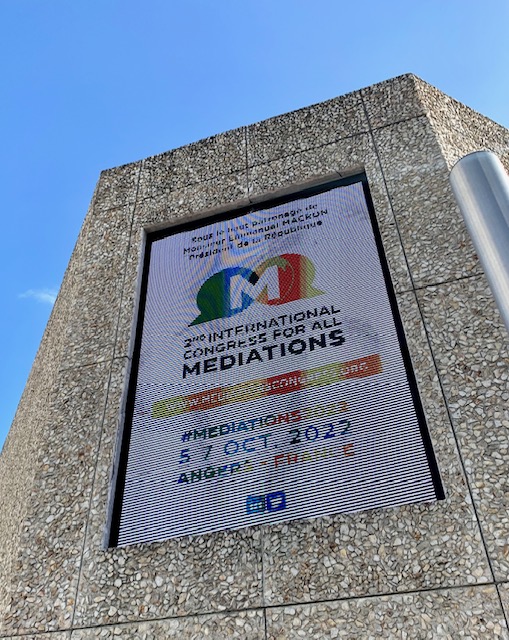
This post reports on the 2nd International Mediation Congress, held in Angers, France, on 5-7 October 2022. Many of the conference sessions explored the role of mediation in citizen-state disputes, including ‘civic mediation’ for collective community disputes and the use of mediation in school-based disputes. The author of this post participated in a conference roundtable discussion on the question of mandatory mediation in administrative disputes, particularly involving social security appeals, public-sector employment disputes, and challenges to decision-making on special educational needs and disabilities. The participants compared attitudes to mandatory mediation from the French, Spanish, and English perspectives.
Mediation and citizen rights
How refreshing to hear mediation being described as opening up access to rights. In her opening speech to the 2nd International Mediation Congress in Angers, Claire Hedon, the Défenseure des Droits for France, described the way her ombud office – and its team of 550 ‘institutional’ mediators across the country – uses mediation to challenge discrimination in housing, address conflict within cities, and secure provision for education support for disabled children. She also described the way, through its mediation work, the ombud acts as a contact point between agencies and authorities, opening up a dialogue that ensures a holistic and networked response to citizen grievance.
The Défenseure des Droits is the national ombud and human rights organisation for France[1]. Her office was involved in a pilot project using mandatory mediation for what are called ‘administrative disputes’, or disputes between citizens and public authorities. The MPO (mandatory prior mediation) pilot involved free mandatory mediation in disputes raised by public employees and those raised by applicants for social security benefits. The pilot was conducted over two years, and the findings from the pilot assessment are examined in a recent report:
‘…it emerges from this experiment and in particular from the qualitative study carried out by the Observatory of the Defender of Rights among claimants followed by the institution from 2018 to 2020 (“Use of mandatory prior mediation: study with claimants”, June 2021), that the MPO is a device that allows new access to rights, in particular for people who would not have gone to court. The mandatory prior mediation system can thus offer a vulnerable public, for whom access to a judge is often difficult, the possibility of free mediation devolved to a neutral, impartial and independent third party. In doing so, it opens up a real space for dialogue conducive to access to rights, whether it is access to information on the right and benefits, access to the benefits themselves and, where applicable, access to the judge.’[2]
One of the conclusions reached by the ombud office is that with increased digitalisation and remoteness of decision-making by public bodies, mediation can offer a much-needed opportunity for in-person dialogue:
‘In conclusion to this study, the Defender of Rights points out that: “people who have used the MPO procedure say that they have found with the Defender of Rights’ delegates an attentive ear and an opportunity for dialogue which they lacked in the context of their ordinary “relationships” with the bodies whose decision they contested. At a time of the dematerialization of public services and the dehumanization that it often entails, this reminds us of the need for direct, oral and even often “face-to-face” contact to allow users to be heard and to assert their rights”.’[3]
A discussion by Sophie Boyron (University of Birmingham) of the mandatory mediation pilot[4] can be found on the REALaw blog here.

Administrative mediation roundtable
Rhita Bousta, Lecturer in Public Law at the University of Lille, was the moderator for the conference roundtable on mandatory administrative mediation. Professor Bousta is the author of The notion of administrative mediation (Harmattan, Paris, 2021) and is an expert in administrative comparative law and human rights. She discusses administrative mediation in an interview for Lexbase Public Review[1] and in a piece on the REALaw blog.[2]
Speakers in the roundtable included Amaury Lenoir, National mediation delegate for administrative courts at the Conseil D’Etat and Referent mediation at the Administrative Court of Nice. Amaury discussed the outcome of the MPO pilot and the benefits of mandatory mediation in this context. He reported that during the pilot, more than 4,800 mandatory mediations were conducted, with a success rate (agreements) of nearly 76% and an average duration of less than two months. The findings of the pilot fed into Parliamentary debates on new legislation that puts the provision of mandatory mediation on a permanent basis in relation to disputes involving public-sector employees (the Pôle emploi), education (the Ministry of National Education) and social security (the management centers of the territorial public service).
Also speaking from the French perspective was Bertrand Maréchaux, a mediator and honorary prefect, head of the administrative mediation commission of the ANM (National Association of Mediators) and retired judge. Bertrand considered the obstacles to administrative mediation in France. He suggested that a cultural attachment to the law and legalism, as well as to the written word, hinders the take-up of mediation: ‘it is the written word and the legal reasoning that must take precedence. Fairness cannot take precedence over law,’ he said. Other obstacles are the perceived legitimacy of the state and the decision-making of public authorities, which is often considered not to be amenable to negotiation; and the need to deliberate on the agreement, or even have it approved by the court, hampering decision-making within mediation.
The position in Spain was explored by Manel Canyameres, a lawyer and an independent mediator, who explained that there is a distinction to be made between external (known as ‘liberal’) mediators and institutional mediators. In Spain, the latter are the ombuds or sindicos (territorial mediators). However, when administrative disputes are mediated, these mediations are conducted by external mediators. In his view, this distinction is important in the context of disputes between citizen and state, particularly when discussing mandatory mediation. Although Spain has not introduced mandatory mediation for administrative disputes, progress has been made: there are no limits on the types of disputes that can be mediated, and each Autonomous Municipality of Spain (territorial division like the Departments in France) has made it possible to implement mediation ‘within the jurisdictional framework’.
I contributed a view from the UK – or more accurately, from England, where mandatory mediation has been proposed by the Ministry of Justice, for small claims in county court, and by the Department for Education, for disputes involving special educational needs and disabilities (SEND). My point is that in adopting the claims made for mediation in civil and commercial disputes (that it is faster and cheaper), policy-makers in administrative justice disputes devalue what mediation can offer in citizen-state disputes and fail to take account of the ways that these areas of dispute often involve fundamental rights and issues of trust and a wider public interest.
In the special educational needs and disabilities (SEND) context in England, mediation remains voluntary, although there is a current requirement to consider mediation before lodging an appeal to tribunal, and there is a proposal to require participation in mediation. The impetus for mediation in this context is usually a challenge to a specific local authority decision that can be appealed to the Tribunal, but in reality the mediation encompasses a multiplicity of issues that go beyond the grounds for appeal, reflecting the ongoing relationship between families and schools and local government. It is not only the interests and needs of the parties attending that have to be taken into account. Collective interests are inherent in the duties that local authority SEND teams have for accounting for use of public funds, in schools’ needs to be supported, and in the needs of all pupils in the community to have access to inclusive education. Mediation in this context is not necessarily a cheaper faster alternative to the tribunal. Instead, it is a means of democratic co-design that offers the promise of addressing both individual and collective needs; it is essentially about connection, and it embraces conflict as a positive force for change.
Yet UK Government policy for the past 25 years has set out to promote mediation and other informal mechanisms of resolution as an answer to the perceived ‘problem’ of overcrowding in, and lack of access to, the formal justice system. What is needed, however, is an integrated network of complementary approaches that embraces a form of mediation that is more than about resolution or settlement. This shift does not prioritise cost and speed; instead it prioritises principles of openness and community interest that are compatible with fostering democratic engagement and accountability, mutualism and difference.
At the roundtable, participants expressed a range of views about mandatory mediation and questioned what is meant by ‘mandatory’. In England, as elsewhere, there are requirements to consider mediation in some areas of dispute (family, SEND), but so far no requirement to engage in the mediation process. Some mediators take the view that because settlement is not mandatory (ie the parties always have the option to leave mediation without reaching an agreement), there is no contradiction between mandatory participation in mediation and the values of voluntariness and self-determination that are fundamental to the process.
There were also widely shared views about the role that mediation has in administrative disputes. Rhita Bousta noted in the previously cited interview with Lexbase Public[3] that in the context of citizen-state disputes, mediation should not be positioned as an alternative to the courts but as a distinct and complementary process.
Pedagogical mediation
One of the concepts that has been discussed in the context of the MPO pilot is that of pedagogical (or educational) mediation. This is when the public authority does not agree to change its initial decision (the decisions being challenged by the individual citizen or groups of citizens), but the mediation offers an opportunity to clarify the reasons for the decision. A successful outcome described as ‘educational mediation’ therefore is one in which the decision is accepted by all parties.
We lack this concept in the UK; although such outcomes are achieved in mediation, they are often considered by the individual and his or her legal representatives as a concession rather than a successful outcome. A concept of ‘educational‘ or pedagogical mediation requires much greater public confidence in decision-making by public authorities than is currently experienced in England.
Sophie Boyron discusses this concept of educational mediation in a blog post on REALaw in November 2022, in which she notes that more research is needed on this and other aspects of administrative mediation. ‘To work’ , she writes, ‘educational mediation would need to be part of a wider package of measures to re-acquaint and reconnect the public with public administration and its public employees.’[1]
If we are to position mediation as more than a settlement mechanism, we should embrace the idea that in some cases (where decision-making is robust and transparent) the dialogue in mediation will result in better understanding, and acceptance, of the public authority’s decision. Mediation in this sense is therefore more than mere dispute resolution or the creation of a safe space for negotiated justice. It becomes instead a technique for allowing citizens’ voices to be heard, for constructing bridge-building dialogue and for the restoration of relationships that are public and institutional rather than private and personal. In order to achieve that, there needs to be a channel by which lessons learned in mediation can feed upstream, back into initial decision-making, in order to improve decisions and derive benefit from mediation’s preventive potential.
One fascinating outcome of the roundtable discussion on mandatory administrative mediation is the recognition that mediation and initial decision-making are intertwined. Although in the UK we are far from accepting mandatory mediation in administrative justice contexts (compared with wider acceptance of it in civil and commercial disputes), it is clear that any attempt to harness the added value that mediation can bring requires improved initial decision-making by public authorities.
Where next for administrative mediation in the UK?
The pockets of administration where mediation currently takes place across the UK make up an ad hoc patchwork of isolated areas of practice – education, tax matters, planning, health care. Each government body that engages in mediation to resolve disputes with citizens develops its own set of procedures and practices. For example, the NHS uses mediation for a large number of clinical negligence claims, through its NHS Resolution scheme, which contracts with an independent mediation provider. Others employ in-house staff trained as mediators, such as the Parliamentary and Health Service Ombudsman. Some administrative mediators are specially accredited, such as in special educational needs, but most are not. Very little public reporting is done by any of the administrative mediation schemes in existence.
What is needed is initial scoping research to identify how, and for which disputes, administrative mediation is happening in the UK. A next step would be to take on board the recent work by the Council of Europe’s European Commission for the Efficiency of Justice (CEPEJ), in its survey member states and subsequent guide to administrative mediation, which is not well known in the UK.[1] Collaboration on creating a public-sector mediation model could be an innovative exercise in design thinking, employing fresh thinking on orthodoxies such as confidentiality and the role of ‘settlement’ as well as explorations of mediation’s added value in disputes involving wider public interest, human rights and equalities, and collective citizen grievance.
Margaret Doyle is a Visiting Research Fellow at the University of Essex School of Law and an independent mediator. She has conducted research on the use of mediation in small claims, in judicial review, in ombuds practice and in education. She is the co-author, with Nick O’Brien, of Reimagining Administrative Justice: Human Rights in Small Places (Palgrave Macmillan, 2019).
[1] A recent area of the Défenseure des Droiuts’ work involves receiving complaints from Liverpool football fans about their treatment by French security forces at the Stade de France stadium on 28 May 2022. The work of the Défenseure des Droits in relation to security forces is explained in this English-language leaflet: https://www.defenseurdesdroits.fr/sites/default/files/atoms/files/dep-deonto-100×210-eng-num-05.22_01.pdf.
[2] Ibid.
[3] S Boyron, “Experimenting with compulsory mediation: assessment and continuation”, REALaw.blog available at https://realaw.blog/?p=1225
[4] ‘What news for administrative mediation?’, Interview with R Bousta, Yann Le Foll, available at https://www.lexbase.fr/article-juridique/74610888-document-elastique
[5] R Bousta, “Mediation in administrative justice. A comparison between French and Spanish laws in a nutshell”, REALaw.blog available at https://wp.me/pcQ0x2-uf.
[6] ‘What news for administrative mediation – Questions to Rhita Bousta, Lecturer – HDR in public law, University of Lille’, interview by Yann Le Foll, editor-in-chief of Lexbase Public, December 14, 2021, available at https://www.lexbase.fr/revues-juridiques/74610888-document-elastique#OpenLink
[7] S Boyron, ‘A welcome spotlight on administrative mediation’, https://realaw.blog/2022/11/22/a-welcome-spotlight-on-administrative-mediation-by-s-boyron/
[8] CEPEJ, ‘Promoting mediation to resolve administrative disputes in Council of Europe member states’, December 2022, https://rm.coe.int/cepej-2022-11-promoting-administrative-mediation-en-adopted/1680a95692
Reframing mediation’s values in citizen-state disputes
Posted: 24 February 2020 Filed under: administrative justice, Dispute resolution, human rights, Mediation, ombuds, Special educational needs, system design, Tribunal | Tags: mediation, SEN Leave a comment
South of the Border, 1958. Anni Albers. (photo by Margaret Doyle)
I mediate in disputes between families and schools and local authorities involving support for special educational needs and disabilities (SEND). This falls within the arena of administrative justice – the interactions between individuals and communities and state institutions – and in this context of citizen grievance (‘citizen’ referring to anyone subject to decision-making by the state), mediation is not a cheap and fast alternative to litigation. To portray it as such diminishes the promise that mediation holds to humanise state bureaucracy and reposition the citizen-state relationship as one of mutual and shared rights and obligations. In this context, rather than a focus on settlement, mediation’s values should be underpinned by reciprocity and recognition, and linked closely with the ways that we embed social rights in our everyday interactions.
Far from celebrating the alternative mechanisms for giving force to social rights, such as mediation and the ombud, advocates of social rights have often lamented the lack of legal enforcement and argued for ways of making social rights justiciable in the courts. Even when the desirability of process pluralism is accepted (a ‘horses for courses’ approach promoted by the Administrative Justice and Tribunals Council (AJTC 2010)), priority has been given to the courts as the leading protagonist in any future partnership of relevant agencies. Mediation and other informal mechanisms have as a result found themselves relegated to the margins as a means of providing effective accountability for social rights violations.
This is one of the premises of our book, Reimagining Administrative Justice: Human rights in small places (Palgrave 2019), in which my co-author Nick O’Brien and I propose a realignment of administrative justice and human rights, and specifically social rights, as a means of fostering more sustainable and democratic responses to citizen grievance. I am a mediator; he is a tribunal judge. Together we see what increasingly resembles a busy assembly line of complaints and appeals that is costly in human and financial terms without evidence of sustainable improvement. We consider how mediators, ombuds and tribunals can work in a complementary, not competitive, way to support democratic accountability.

New orthodoxies
In the book, we challenge the orthodoxies of administrative justice that prioritise the individual user, a well-oiled system, and closure by ‘resolution’.
The individual user has become sacrosanct in debates about the design of administrative justice. Reflecting the consumerist ambition that the point of reference is the individual ‘user’ of any service and that ‘user friendliness’ is the ultimate aim, proposals for redesign of administrative justice assume that any response to citizen grievance should be judged by how effectively it offers ‘user satisfaction’, whether in accessing a tribunal, mediator or ombud. Yet there are grounds for scepticism about this assumption, not because the user is unimportant but because the true identity of ‘the user’ is frequently contested, rarely simple, and never a matter of purely individual choice, divorced from all social and shared need.
Policy makers and academics often observe that, in contrast to the criminal justice, family justice or civil justice systems, the administrative justice system does not as yet exist, and moreover that this is a bad thing. This observation assumes the desirability of making administrative justice more ‘systematic’, in the sense of more clearly structured and bounded, with practice and process more uniformly prescribed and co-ordinated. This striving for systematisation, for consistency and certainty, looks dubious as an overarching strategy, not least because it fails to take account of the unavoidability of uncertainty and the need to remain ‘agile’ in the face of an unpredictable future. Too much ‘system’ can lead to precisely the uniformity, bureaucracy and inflexibility that administrative justice has always aspired to counter. We suggest recasting administrative justice as less of a system and more of a woven fabric, to look for what Bauhaus weaver Anni Albers described in 1958 as the ‘interdependent threads’ that, when connected, ‘form a cohesive and flexible whole’ (Albers 1965).
And finally, the emphasis on individual redress has reinforced the expectation that any serious attempt to respond to citizen grievance must aim for finality and ‘closure’. Even if the outcome is one of disappointment for the individual complainant, at least the administrative justice process will have brought things to an end, achieved closure and allowed for business to resume. To design for closure, however, is to design for resignation, for the acceptance of limit and definition, for boundary and exclusivity. The ability of administrative justice to engage in iterative practices, deliver provisional outcomes, and enable future creative participation, albeit under the shadow of inevitable uncertainty, is seriously constrained by such an ambition.
Design theory and the ‘problem in relationships’
In proposing the alternative orthodoxies of community rather than individual user, of a network rather than system, and of openness rather than closure, we explored design culture as a source of new ideas. Design theory has begun to feature in discussions about the future of administrative justice, and the prospects of a ‘digital by default’ future require us to reflect on what design might mean for administrative justice and for the fabric of the justice system more generally. The trajectory of design culture in the past 75 years and its own entanglements with democratic values, individualism and the marketplace illustrate how design has been subjected to similar pressures as those exerted on administrative justice and human rights. Innovative and progressive solutions have emerged in design culture, and part of the purpose of this book is to explore the resonance between ideas in design culture and the reconnection of human rights with administrative justice as proponents of a reinvigorated democracy. It is in the design of the public realm, in urban planning and housing development that the values that can shape a reinvigorated democracy become most clearly visible and in which the possibilities for administrative justice and human rights emerge most clearly.
Lack of trust is often cited as being at the core of the problematic citizen-state relationship. That lack of trust works both ways – not only in how the citizen views the state but how state institutions view the citizen. As political theorist Danielle Allen has noted, ‘citizenship is not, fundamentally, a matter of institutional duties but of how one learns to negotiate loss and reciprocity. … unrestrained self-interest does not make the world go round but corrodes the bases of trust’ (Allen 2004:165).
Where does mediation fit into this? We argue that mediation plays an unheralded role in this reshaping of the citizen-state relationship. That relationship is often characterised as one bounded by the constraints of standardised, faceless bureaucracy – but that bureaucracy is the frontier where the citizen meets the state and feels its texture. The problem in bureaucracy is, in turn, a problem in relationships. Human rights and administrative justice are, in their different ways and common origins, both means of humanising those relationships and investing them with democratic credibility.
Our book explores mediation techniques and their potential place as part of a networked and loosely woven administrative justice fabric. The use of the senses is important – looking, listening, even touching, where that suggests a lingering feeling of empathy, of common humanity inherent in an ethic of care approach that recognises the interdependence of citizen-state relationships. Mediation and other so-called extrajudicial institutions of administrative justice are not about policing bad behaviour but about promoting good behaviour on behalf of the community, including good administration. They are therefore well suited to restoring the humanity in bureaucracy, to ensuring that the way we touch the state, and it touches us, is constructive, not destructive.
Mediation as ‘appropriate alternative’ or ‘collaborative complement’?
Two areas in particular illustrate the need for a model that embraces democratic participation and the relaxing of confidentiality rules: planning and development, and special educational needs and disabilities. In both contexts, at least one of the parties is a public authority with requirements to report (to auditors, for example) or to answer to democratically elected representatives (local authority councillors, for example), and both involve consideration of wider community interests (CEDR 2003). Therefore, it may be both undesirable and unfeasible to impose confidentiality on mediation of public sector cases, including but not only multi-party public policy disputes. Critiques of claims for mediation’s advantages of speed, low-cost, and informality are justifiable (Pearce and Stubbs 2000; Bondy, Doyle, Reid 2005), but in a public-interest context it is the promised multi-interest engagement that is more interesting to explore – its added value more than its alleged proportionality.
In the book we examine special educational needs and disabilities (SEND) in England as a case study to highlight mediation’s potential to contribute to the democratic accountability work of administrative justice. In 2018, 3,200 SEND mediations were conducted. This is a complex and multi-faceted landscape, with a range of complaint mechanisms for different types of disputes operated by different public bodies and private actors (schools, local authorities, Secretary of State, the NHS, Ofsted, the SEND Tribunal, SEND-accredited mediators, the Local Government and Social Care Ombudsman, judicial review). It is an area rich with the polycentricity of disputes, with their overlapping web of perspectives, and alive to the tension between individual and collective rights.
In the SEND context the impetus for mediation is usually a challenge to a specific local authority decision that can be appealed to the Tribunal, but in reality the mediation encompasses a multiplicity of issues that go beyond the grounds for appeal, reflecting the ongoing relationship between families and schools and local government. It is not only the interests and needs of the parties attending that have to be taken into account. Collective interests are inherent in the duties that local authority SEND teams have for accounting for use of public funds, in schools’ needs to be supported, and in the needs of all pupils in the community to have access to inclusive education. Mediation as a means of democratic co-design offers the promise of addressing both individual and collective needs; it is essentially about connection, and it embraces conflict as a positive force for change. In that way, it allows for many voices and lends itself to the polycentric nature of SEND disputes.
The ‘sensibility’ of mediation
The ability of mediation to accommodate many voices and issues gives it a distinct texture or ‘sensibility’ that can complement more determinative grievance mechanisms. Mediation works in tandem with tribunals, as in the SEND context, and with the ombud; disputes can be mediated before or even after an ombud investigation, for example (LGSCO 2017:7; OIA 2013). It can also function as a complement to judicial review and the Court of Protection, often in complex cases in which disability rights are at the core (Bondy and Doyle 2011; May 2017).
More often, however, mediation has been presented as an alternative, not a complement, to more formal legal processes and even as an answer to the perceived problems besetting the courts, ‘gridlocked with competing sides or overworked with too-big-to-handle dockets’ (Menkel-Meadow 2002:53-54). Government policy, from Lord Woolf’s Access to Justice report in 1996 through to ‘proportionate dispute resolution’ as advocated in the 2004 White Paper, the 2007 Act, and the 2016 Transforming Our Justice System paper, has set out to promote mediation and other informal mechanisms of resolution as an answer to the perceived ‘problem’ of overcrowding in, and lack of access to, the formal justice system. What is needed, however, is a shift away from an emphasis on proportionate and fast toward an integrated network of complementary approaches that can accommodate the looseness that enables mediation to be more than about resolution or settlement. As we write in Reimagining Administrative Justice, this shift does not prioritise cost and speed; instead it prioritises principles of openness and community interest that are compatible with fostering democratic engagement and accountability, mutualism and difference.
These principles resonate with what has been called the transformative dimension of mediation, linked to ‘an emerging new vision of self and society, one based on relational connection and understanding rather than on individual autonomy alone’ (Bush and Folger 2005:23-24). This reflects a shift from an individualistic vision to a relational and interactive one, bringing individual freedoms together with social conscience. Settlement-oriented behaviour by mediators (often encouraged not only by policy imperatives but by codes of conduct and practice standards) is linked to a wider issue of ‘conflict control’ and to the fundamentally pessimistic ideology identified by Bush and Folger that holds that because human beings are ‘incapable of engaging with one another without destructive consequences’, social interaction is a destructive force (Bush and Folger 2005:247).
If this seems over-dramatic, consider the language used in some descriptions of the mediator’s role – to ‘control’ the process, ‘manage’ emotions, helping people to move away from ‘unreasonable’ positions – and some techniques, including keeping parties apart in caucus sessions, coercion and even bullying by mediators (Genn et al 2007; Enterkin and Sefton 2006). Mediation is not about neutrality, contrary to popular belief, nor is it about managing or controlling conflict. Concerns about the dangers of interaction are rooted in the view that individuals are driven by desire of fulfilment and that interaction must be limited and controlled so it meets that need but does not spill over into conflict, which is something to be managed in what is called ‘conflict control’. A ‘conflict-control’ model relies on a deficit view of human capacity linked to an ‘ideology of individualism’ and a notion that social interaction should be ‘tolerated but watched carefully’ (Bush and Folger 2005:245).
New priorities
I’m not against settlement or resolution. In many contexts it is what parties want and is an acceptable ambition. In the spaces of citizen grievance and public administration, however, rather than measuring the success of mediation by the number of settlements achieved, we should be aiming for mediation to be measured in terms of sustainability – whether it offers an alternative to the assembly line of complaints and appeals that the administrative justice ‘system’ increasingly resembles. Sustainable outcomes are possible when the interaction between people in conflict is open, iterative and deliberative, not funneled toward settlement.
Mediator and academic Carrie Menkel-Meadow suggests that mediators are reshaping the processes they use to move away from a focus on resolution and ‘right answers’ to focus on the ‘sensibility’ of mediation, one that adopts a feminist emphasis on needs and that prioritises empathy and listening rather than closure. She writes of what she considers to be ‘mediation values’ – reconciliation, listening, storytelling, empathy, understanding, accountability and apology, if not forgiveness – being used in both large and small arenas, including in human rights claims and in controversial community-wide issues. One such arena is SEND, which entails social rights and state decision-making and must accommodate often competing collective and individual needs, and in which such a reshaping is necessary.
Mediation in this sense is therefore more than mere dispute resolution or the creation of a safe space for negotiated justice. It becomes instead a technique for allowing citizens’ voices to be heard, for constructing bridge-building dialogue and for the restoration of relationships that are public and institutional rather than private and personal.
References:
Administrative Justice and Tribunals Council (AJTC) (2010). Principles of Administrative Justice. London: AJTC.
Albers, A (1965). On Weaving. Middletown, CT: Wesleyan University Press.
Allen, D (2004). Talking to Strangers: Anxieties of Citizenship since Brown v. Board of Education. Chicago: University of Chicago Press.
Bondy, V and Doyle, M (2011). Mediation in Judicial Review: A practical handbook for lawyers. London: Public Law Project.
Bondy, V, Doyle, M and Reid, V (2005). Mediation and Judicial Review – Mind the Research Gap. Judicial Review 10(3), 220-226.
Bush, RAB and Folger, JP (2005). The Promise of Mediation: The Transformative Approach to Conflict. San Francisco: Jossey-Bass.
Centre for Effective Dispute Resolution (CEDR) (2003). ADR for public authorities: A guide for managers. London: CEDR.
Enterkin, J and Sefton, M (2006). A report on the Exeter Small Claims Mediation Pilot. DCA Research Series 10/06. London: Department for Constitutional Affairs.
Genn, H et al (2007). Twisting arms: court referred and court linked mediation under judicial pressure. Research Series 1/07. London: Ministry of Justice.
Local Government and Social Care Ombudsman (LGSCO) (2017). Education, Health and Care Plans: Our first 100 investigations. London: LGSCO.
May, C (2015). Mediating Court of Protection cases – Summary of research. UK Administrative Justice Institute (UKAJI) blog.
Menkel-Meadow, C (2002). When Litigation Is Not the Only Way: Consensus Building and Mediation As Public Interest Lawyering. Washington University Journal of Law and Policy 10, 37-62.
National Audit Office (2018). Handling of the Windrush situation. HC 1622 Session 2017–2019. London: National Audit Office.
Office of the Independent Adjudicator (OIA) (2013). Mediation – a guide for students. Reading: OIA.
Pearce, B and Stubbs, M (2000). The role of mediation in the settlement of planning disputes at appeal: the debate and research agenda. Environment and Planning 32, 1335-1358.
Save the planet and mediate!
Posted: 9 July 2014 Filed under: administrative justice, Disability, discrimination, Mediation, system design, Tribunal | Tags: mediation, SEND Tribunal Leave a commentSave the planet, mediate: could this be a new argument for mandatory mediation?
At a recent meeting about the SEND tribunal, which hears challenges to local authority decisions about special educational needs, I learned that the average evidence bundle is 350 pages, and some bundles run into the thousands of pages. Aside from sympathy for the parties who have to prepare these bundles, and for the tribunal members who have to read them, this fact should generate concern for the environmental impact of so much paper.
In contrast, mediations of these tribunal appeals usually involve a 1-2 page Agree to Mediate statement from each party and, where applicable, the child’s statement of special educational needs (SEN) (soon to be the EHC Plan). Parties might bring along their files and other papers, but they are rarely used during the mediation.
Arguing that its environmentally friendly approach is a good reason to make mediation compulsory is frankly absurd. But is it any more absurd than arguing that mediation should be compulsory because it is cheaper and faster than the tribunal?
From September 2014, we will see the introduction of the first mandatory mediation in the UK. That it has so far remained under the radar is due in part to the specialist area of SEN being an unfamiliar area of mediation practice. It falls between the cracks of non-family civil mediation, despite being the longest running area of mediation in the public law and administrative justice arena. Because the claims are not money-based, it isn’t reflected in the Ministry of Justice’s Civil Mediation Database. Because it isn’t commercial mediation, but nor is it family or community mediation, SEN mediators cannot join the Civil Mediation Council as individual mediator members.
In the UK we have resisted attempts to make mediation mandatory. We’ve had experiments with compulsion in the past, such as with the Automatic Referral to Mediation pilot in the London Central County Court in 2004-05 that was evaluated by Professor Hazel Genn. One of Genn’s findings was that efforts to introduce compulsion led to lower settlement rates, from 69% to 38% during the course of the pilot, and subsequently led to higher costs for parties. The pilot was not rolled out.
Other ways of compelling parties are more surreptitious. They include introducing or raising fees to lodge legal claims (as with employment tribunals), requiring parties to attend a mediation ‘information and assessment meeting’ (as in family cases), and withdrawing legal aid that allows parties to get advice (as in all but very few excluded types of cases). We’ve seen that the government’s attempts to promote the use of mediation in family disputes has spectacularly backfired, with the number of mediations plummeting since the withdrawal of legal aid means that people can no longer access the lawyers who can give them confidence in trying mediation.
With the new requirement in SEN cases, we see a different way of dipping our toes into the mandatory waters. Water is an apt metaphor, given the arguments made by some mediators and members of the judiciary that although you can’t make a horse drink by leading it to water, most horses do actually drink, once they find the water as pleasurable as it is marketed to be. In other words, once people get to the mediation table (even if that’s by force) they will find the process helpful.
The new measures to come in this September are part of the reform of special educational needs provision in the Children and Families Act 2014. If parents want to lodge a challenge to a local authority decision on SEN, they will be required to consider mediation – like the MIAM requirement in family mediation, this means obtaining information about mediation and a certificate from a mediation adviser. Without that certificate, a parent can’t lodge the appeal. If parents decide they want to mediate, the local authority is required to mediate. The twist is that compulsion is for the local authority only.
This is the first instance of mandatory mediation (not just mandatory mediation information) in this country, and it’s being introduced with very little outcry.
Don’t get me wrong – I’m a big fan of mediation for SEN and disability disputes. Mediation works well in these cases, as years of experience and hundreds of cases has shown. My colleagues and I at the London SEN Mediation Service, run by the national charity Kids, have since 2003 seen the way mediation can help parents, schools and local authorities reach holistic and long-lasting agreements that put the child or young person at the heart of the resolution. But we were also among the majority of mediator respondents to the Department for Education’s consultation last year who argued vehemently against mandatory mediation for these cases.
Mediation is a wonderful resource and should be available to all, but it isn’t the answer in all cases. It takes time and effort, and to get a sound result you need the right people, senior people, to attend. For a number of reasons parties might legitimately decide not to mediate, and it serves no one to have parties attend reluctantly or to send a representative to mediation who doesn’t have the authority to settle. Furthermore, the risks introduced by the new requirement and the associated timescales will make mediation less, not more, attractive.
We might find that money is spent on mandatory mediation information provision (paid for by already over-stretched local authorities) and the issuing of certificates, and that numbers of actual mediations go down while tribunal numbers remain the same. The winners in this game are likely to be only the certificate-issuing mediation advisers. The losers are the parents and local authorities who will be forced to jump new hoops, and the children and young people whose provision might be further delayed.
Gazing at the ADR landscape – Is the EU Directive just a mirage?
Posted: 9 October 2013 Filed under: ADR, Dispute resolution, Mediation, system design | Tags: appropriate dispute resolution, consumer complaints, EU ADR Directive, mediation, ombudsmen Leave a commentAs a North American transplant to this cynical and self-deprecating island, I usually find I’m the lone Pollyanna in the room. Seeing the sunny side is part of my national nature. It doesn’t help that I’ve been a mediator for 25 years and am trained to see opportunity in adversity and promise in conflict.
But I’m more Cassandra than Pollyanna when it comes to the European Union ADR Directive and the excitement those unexciting words seem to inspire among colleagues in the dispute resolution world.
The Directive is aimed at addressing the gaps in consumer redress within and across European Union countries. It requires member states to ensure that there is independent appropriate dispute resolution (ADR) available for consumers to use as an alternative to courts for resolving disputes with traders and businesses. ADR must be free or low cost, accessible, quick and transparent.
So far, what’s not to like?
The main problem is that member states can choose whether or not to make businesses sign up to ADR, and Britain is unlikely to go down that route – this government has an allergy to anything that looks like regulation or bureaucracy or constraints on market freedom. So the upshot is that reputable businesses, ones that want to provide good customer service and can afford to pay for independent redress, will engage with the new requirements. The rogues of the consumer world – and not just the rogues, but the tiny, the tired and the overstretched – are all likely to say ‘no thanks’ to a consumer asking for independent redress. So ADR will be available, but it won’t necessarily be used. It could all turn out to be an exercise in fancy window dressing.
But not being used isn’t the worst thing that could happen – consumers who can’t get their trader to use an ADR scheme can still use the courts – and the small claims procedure in many ways is becoming more accessible and user friendly. I know from previous research I’ve carried out with court users that the fear of court is often unfounded; people are surprised to find they could manage the process without a lawyer. The small claims procedure has most of the attributes set out as desirable in an ideal ADR scheme – independent; a low barrier (court fee) that acts as an effective filter for vexatious complaints; a mediation option available if both parties agree, and a binding legal determination if necessary. Speed for small claims is variable but can be weeks rather than months or years.
What worries me more is what kind of dispute resolution we might end up with. In order to make their product attractive to businesses (which are the target ‘customers’, because they’re the ones paying for it), ADR providers will be pressured to compete on price and provide cheap and cheerful dispute resolution. That might suit some disputes, but not others. The Directive doesn’t distinguish between ADR processes, so mediation is lumped with arbitration, ombudsmen with conciliation, all in a soupy mix. Is anyone considering what types of dispute resolution work best for which consumers, which complaints?
I suspect that the ombudsman model – and in particular its emphasis on seeking evidence and on feeding back to the profession or industry complained about in an attempt to improve the actual services and internal complaint handling – will be pushed out in favour of a complaints’R’us approach – an assembly line of escalated complaints, which can offer a cheaper cost basis for the businesses that are its customers. Businesses could even find it’s cheaper to send their complaints to the ADR scheme rather than handle them properly themselves.
Is that what we’re aiming for? I’m open to being wrong, and indeed hope I am. But for now Cassandra is winning over Pollyanna in the landscape gazing.
Where do campus ombuds fit in?
Posted: 7 September 2012 Filed under: Dispute resolution, higher education, Mediation, ombud, ombuds, ombudsmen, ombudsperson, system design | Tags: campus ombuds, dispute resolution, higher education, mediation, student complaints, universities Leave a commentSeptember 2012
Student complaints: are campus ombuds the answer?
The potential role of campus ombudsmen is a bit of a hot topic at the moment in England and Wales, at least in the world of student complaints. Campus ombuds have been around for some time in the USA. Most universities there seem to have someone in this role. In the UK, however, they are a relatively little known phenomenon.
What is a ‘campus ombuds’?
The International Ombudsman Association (IOA, http://www.ombudsassociation.org), the professional body for ombuds in the USA and elsewhere, describes different types of creature – classical, organisational and advocate ombuds. Campus ombuds fall into the organisational ombuds category, which the IOA defines as ‘a designated neutral who is appointed or employed by an organisation to facilitate the informal resolution of concerns of employees, managers, students and, sometimes, external clients of the organisation’.
Most campus ombuds operating in the US do not investigate complaints themselves but act as a resource for staff and students who experience difficulties and might be considering raising a formal grievance. Although operationally and personally independent, they are for the most part accountable to the university that employs them. Their operational independence therefore depends on the respect given to the role by the university administration and on the ability of the individual ombuds to resist any attempt to compromise their independence.
A model example
To find out more, I recently met with David Rasch, the campus ombuds of Stanford University, a private university in Palo Alto, California that has some 15,000 students and around 2,000 academic staff.
David describes his role as a confidential resource; he emphasises empowerment and he uses mediation approaches, although he is not a trained mediator. He describes what he does as:
- non-judgmental and supportive listening
- confidential discussion
- coaching people to independently negotiate and resolve problems
- identifying and reframing roots of the problem
- developing strategies for resolutions that fit all parties’ interests and goals
- opening channels of communication
- negotiating, facilitating or mediating between some or all parties
- developing and recommending systemic solutions
Unlike ombuds here in the UK, David (and his campus colleagues throughout the States) does not conduct formal investigations. Interestingly, he can initiate an inquiry if he becomes aware of an issue – a power not shared by most of the ombudsmen in the UK, who can only take on a complaint that has been raised by an individual complainant (or group of complainants). He keeps no records of any discussions, something that helps protect the confidentiality he promises to those who use his service.
With a PhD and a background in psychology and counselling, David manages to gain credibility from both staff and students as well as wider staff at the university.
Using the campus ombuds is voluntary, and he has no targets to meet in terms of reducing the number of formal grievances or legal claims against the university. Staff and students with a problem are encouraged to see him before filing a grievance, and he asks them to say (in a feedback form) whether they would have used a formal process if they had not gone to him. From this he has a sense of the impact of his work.
About half the complaints he sees relate to employment issues from non-academic staff. Another 15% are from academic staff, and these tend to relate to the tenure process, problems with students and departmental politics. Just over one-third are student complaints, and these range across undergraduate and postgraduate students. He reports monthly to the university’s President on demographics and types of cases but not on specific cases.
Independence
Campus ombuds have been referred to by critics as a means to “stop students from occupying the dean’s office” and by proponents as a “conscience on campus”.[1] Listening to David, my sense was that the role of campus ombuds is hugely valuable, albeit possibly more so for a university’s administration than for a university’s students or staff. Ombuds can keep grievances and grumbles from escalating into full-blown legal claims, ever a consideration in such a litigious country. But even for those with the grievances or grumbles it offers a low-key way to deal with them without inviting the personal and professional destruction that so often accompanies disputes.
However valuable the role, however, it is one that depends heavily on the integrity and robustness of the individual ombuds, and there appears to be little protection for those post-holders pressured by an unsavoury administration to breach confidence or keep a lid on dissent. I have no doubt that David Rasch at Stanford is solid in both these characteristics. Others might not be, and their appointment and dismissal is at the whim of the administration.
Useful in the UK?
How might this role work here in the UK?
This summer the Department for Business (BIS, which oversees higher education in England and Wales) published its response to its White Paper ‘Students at the heart of the system’ and its subsequent Technical Consultation.[2] Buried within a long document addressing student finance and regulation of higher education is a brief mention of campus ombudsmen. BIS notes that among respondents to its consultation, ‘The idea of campus ombudsmen and regional networks was supported by many but seen as unnecessary or inappropriate by others.’
Not an overwhelming endorsement, then. It will be interesting to see how the issue of campus ombuds is handled by the Office of the Independent Adjudicator for Higher Education (OIA) in its response to its own Pathway 3 Consultation. This consultation was carried out in late 2011 (see www.oiahe.org.uk) after the OIA was tasked by BIS to consult on ways to encourage early dispute resolution. The OIA is expected to publish the results and its response soon. The issue is also the focus of work carried out by the Improving Dispute Resolution Advisory Service (IDRAS), a consultancy body for higher education.[3]
The OIA and IDRAS
For those of you who aren’t familiar with either body, a bit of background. The OIA was established in 2004 and is the independent reviewer of student complaints about higher education institutions in England and Wales. It can only take on complaints once they have been through the university’s internal complaints procedure. Yet recent years have seen a steady increase in complaints, with resulting pressure on its staff to deal with cases more quickly. Meanwhile, complaints appear to be growing more complex.
IDRAS covers both student and staff disputes within universities. It produced, in 2008 and 2009, several reports on the state of play of dispute resolution within universities, including an overview of campus ombudsmen.
The OIA’s Pathway 3 consultation sought views on how best to promote the resolution of complaints at an early, internal stage, including the introduction of a campus ombudsman role. The consultation included a survey of the campus ombuds role in other countries, including Australia and the USA, where the role is well established.
‘Ombudsman’ culture in the UK
Here, the term ‘campus ombuds’ is problematic. We have a professional body, The Ombudsman Association (formerly known as the British and Irish Ombudsman Association, or BIOA), whose members are the various complaint-handling schemes for central and local government, housing and various private sectors, including utility companies, financial services and legal services. The OIA is a full voting ombudsman member, as is the Scottish Public Services Ombudsman, which investigates complaints about higher education in Scotland. This means both schemes meet the Association’s membership criteria – including independence and accountability, as well as the power to investigate complaints and make determinations.
Campus ombuds in this sense would not meet the criteria for full membership of the Ombudsman Association. Furthermore, introducing a campus ombuds role here would risk creating confusion with what is in effect a national ombudsman scheme, the OIA, and put in place yet another hurdle for students to overcome before their complaint can be considered independently.
Mediation, not campus ombuds
In the UK we already have a range of mediation options for student complaints that could be developed in the push for more early dispute resolution, before complaints go to the OIA, or even in conjunction with an OIA investigation. There are a few well-established campus mediation services including Dundee University (see http://www.dundee.ac.uk/academic/edr/), which has been operating since 2009, as well as mediators and mediation providers with expertise in higher education (eg Equalities Mediation Service (www.equalities-mediation.org.uk) and IDRAS).
As a mediator with many years of experience in disability discrimination claims in higher education, I confess to having an interest in seeing more mediation taking place, and earlier, in such cases. I see the damage done to students and universities when complaints are dragged out over many years, limiting the options for resolution.
But my vision is not to steer all student complaints into mediation by default. It isn’t right for every case, or for every party in dispute. It is one of a range of tools that should be available for resolving such complaints, and it sits neatly with the authoritative role and investigative expertise of the OIA and, in Scotland, the Scottish Public Services Ombudsman. I’m not averse to having campus ombuds as an additional tool, but I worry that it will provide another hurdle and will add to the time involved in resolving student complaints. I also worry that it will be expensive for individual universities to establish and maintain an ombuds office. And I worry that, without independence, it won’t be a role trusted by students.
Instead, I’d like to see regional networks of specialised, independent mediators established, with the OIA’s support, which universities can call upon as and when needed, and as early as possible in the life of a dispute.
I look forward to seeing the OIA’s response to its Pathway 3 consultation. I’m hoping it will challenge assumptions about how the concept of campus ombuds will translate here and that it will explore the benefits of having access to independent mediation for student complaints.
[1] As quoted by S.A. Weigand, ‘A Just and Lasting Peace: Supplanting Mediation with the Ombuds Model” (1996) 12 Ohio state Journal on Dispute Resolution 1, pp.120-22.
 domarmediation